
A corrugated box can arrive in good condition and still be awkward to use in a store. The opening may be unclear, the remaining tray may be difficult to position, or the front wall may interfere with access to the products it holds. A successful retail-packaging brief therefore needs to consider the moment after delivery as carefully as the journey itself.
Corrugated shelf-ready packaging brings those two stages into one design discussion. For brand owners, distributors and retail teams, the goal is to define a corrugated case or tray that suits the product, the delivery process and the receiving store's workflow.
Cuboid Packaging focuses on corrugated packaging. This guide examines corrugated outer cases and display trays, with practical questions to raise before approving a sample or placing a production order.
Quick answer: Begin with the retailer's requirements, the packed product, the shelf space and the handling sequence. Review how the corrugated case opens, how the remaining tray behaves and how the design performs in a representative trial. Approve the complete specification, not only a photograph.
Describe the retail task before choosing the box style
Start by writing down where the packaging will be used. A local store, supermarket distribution network and temporary promotional display may follow different replenishment processes. Ask the receiving team how the delivery is checked, stored, opened and placed on the shelf.
Identify the specific problem the new design should address. Perhaps staff currently remove each item from a shipping case, or perhaps a tray already exists but does not fit the allocated shelf position. A precise problem makes the sample review more useful than a general request for attractive packaging.
Avoid assuming that one retailer's preferred arrangement suits every outlet. Keep the intended channel and the person who confirmed its requirements in the brief. If several channels are involved, record the differences before asking the supplier to propose a common structure.
Understand the corrugated structure being discussed
Corrugated packaging uses a fluted paper structure with liner material. The visible wavy layer is part of what distinguishes the material and its construction. The appropriate board and structure must be selected for the application rather than chosen from appearance alone.
Ask the supplier to explain the proposed corrugated board specification and the reasons for it. Provide the packed weight, product dimensions, arrangement, handling conditions and relevant storage information. Do not assume that stating only the number of plies communicates the complete requirement.
For discussing structural styles, the FEFCO code provides a shared system of corrugated packaging designs. A style reference can make the conversation clearer, but it does not by itself establish the finished pack's suitability or replace an agreed specification and trial.
Map the journey from receiving area to shelf
Draw a short sequence: receiving, temporary storage, opening, shelf placement, replenishment and removal of the empty packaging. Beside each step, note who handles the case and what information they need. This exercise often reveals requirements that are missing from the artwork brief.
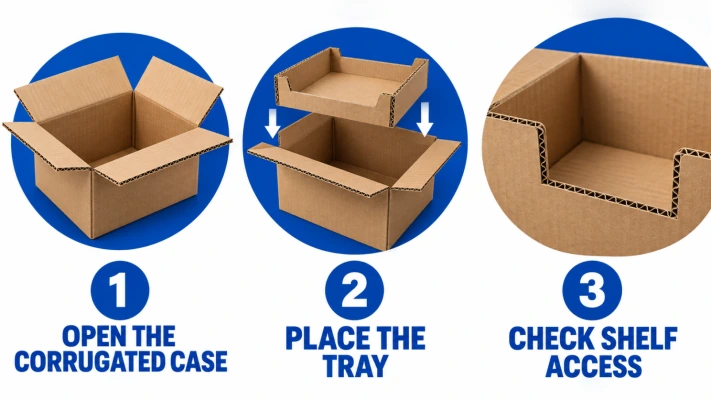
At receiving, identification may matter most. During opening, the structure and instructions become important. On the shelf, access and presentation matter. When the tray is empty, staff need a practical way to deal with the remaining corrugated material under the store's waste arrangements.
FEFCO's shelf-ready packaging guidance describes five useful considerations: identification, opening, shelf placement, shopper access and flattening for recycling. Use these as discussion prompts, then validate the specific design against the retailer's actual requirements.
Give the supplier a complete product arrangement
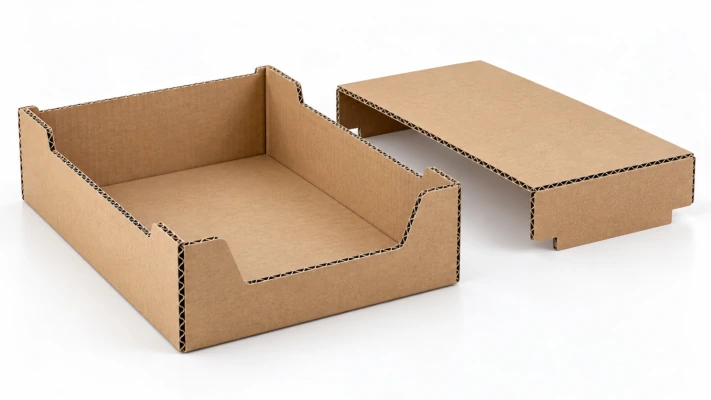
Provide the actual dimensions and packed weight of the products the corrugated case must contain. Show how many units are intended in one case and how they should face when displayed. Where there are different variants, explain whether they share the same dimensions and weight.
Supply representative samples where practical. A drawing helps, but a physical review can reveal how the contents settle, move or interact with the tray walls. Agree which product version the sample represents so a later product change does not silently invalidate the packaging approval.
If the display quantity is undecided, identify who will approve it. A larger case count may affect handling and shelf use. A smaller count may change replenishment frequency. Those are operational decisions to discuss with the relevant teams, not assumptions the packaging supplier should make alone.
Treat the opening feature as something to test
A perforation, removable section or separate corrugated cover needs to work as part of the complete pack. Ask the sample reviewer to follow the proposed opening method without a verbal demonstration first. Their questions reveal whether the intended action is clear.
Record where the person naturally grips the case and whether the opening leaves the tray in the intended condition. Inspect the result rather than judging only the unopened sample. Photograph the opening sequence and the finished tray so later reviewers can see the same evidence.
Use the retailer's approved handling procedures during trials. Do not encourage improvised cutting near contents or unsafe opening methods. If the sample cannot be opened in the intended way, record the issue and ask for a structural review rather than simply adding more instructions to the artwork.
Review the tray with the intended shelf
Ask for the available shelf width, depth and clearance, together with any retailer-specific placement rules. Test the proposed corrugated tray against that space. An attractive sample on a large meeting-room table does not demonstrate that it suits a narrower retail shelf.
Review the tray both full and partly depleted. Check whether the remaining arrangement still allows the products to be identified and accessed as intended. Discuss how staff will replenish the display and whether the tray will be reused for that purpose or replaced according to the agreed workflow.
Include the relevant retail team in this review. Their feedback can distinguish a structural problem from an incorrect shelf assumption. Record the agreed placement and orientation so the approved sample does not later appear in a different configuration without assessment.

Keep corrugated print information useful
Decide what needs to be read at each stage of handling. The information used in the receiving area may differ from the information visible after the case is opened. Mark which panels remain on the shelf and which panels are removed.
Check the artwork on the physical corrugated sample at a realistic viewing distance. Consider how folds, cut-outs and opening features interact with the information. A design can look balanced on a screen yet place an important identifier across a structural feature.
Use a controlled artwork file and record its revision. Ask the relevant brand and retail contacts to approve the information they own. Packaging approval is easier to manage when responsibility for copy, identifiers, dimensions and structure is explicit.
A fictional sample trial that finds a better question
Imagine a fictional household-products brand preparing a corrugated shelf-ready case for a retail trial. Its first review concentrates on the printed front panel. The sample looks neat, and the team is ready to approve it from photographs.
During a store trial, staff discover that the allocated shelf position differs from the dimension assumed in the brief. They also need clearer identification on a panel visible while the cases are waiting in the receiving area. The supplier has not failed a stated requirement; two requirements were never properly recorded.
The team updates the brief, confirms the retail space and requests a revised sample for review. This is an illustrative planning example, not a Cuboid customer testimonial or a claim of measured savings. Its lesson is to test the complete retail task before treating artwork approval as final packaging approval.
Sample-review principle: Ask whether the sample works for the people who will handle it, in the place where they will use it.
Agree a representative validation plan
Discuss the relevant packing, handling, transit and storage conditions with the supplier and the customer's responsible team. Agree what evidence is needed to assess the proposed corrugated construction. The appropriate checks depend on the product and distribution route.
Keep an appearance review separate from performance evaluation. Neither an attractive print finish nor a familiar-looking box style establishes how the packed design will behave in the intended conditions. Where formal testing is required, agree the method, acceptance criteria and responsible parties.
Document any limits of the trial. A sample reviewed in one store and one distribution arrangement should not automatically be described as approved for every channel. If the route or packed product changes, assess whether the existing approval still applies.
Make the approved sample traceable
Keep a signed or otherwise formally approved reference sample according to your purchasing process. Link it to the drawing, board specification, dimensions, print revision, packing arrangement and agreed acceptance information. A photograph can support that record but should not be its only content.
When a change is proposed, state what is changing and why. A different product count, opening feature or material proposal should not be introduced through an informal conversation that never reaches the people responsible for approval.
Also define the first-production review. Decide who will inspect the initial supply against the approved reference and how discrepancies will be reported. Clear records make the discussion more specific than a complaint that the box “looks different.”
Your enquiry checklist
Frequently asked questions
Is every corrugated shipping box shelf-ready?
No. Shelf-ready use needs its own design brief and review. A shipping case may protect a delivery without providing the intended opening and display arrangement.
Is the ply count enough to order the design?
It is not a complete specification. Discuss the full corrugated construction, packed product and operating requirements with the supplier.
Can we approve from a digital picture?
A digital review is useful for discussing appearance and layout. It does not replace the physical and performance checks agreed for the application.
Should the supplier decide the shelf quantity?
The supplier can support the design discussion, but the quantity should be agreed with the brand and relevant retail team using the actual product and shelf requirements.
Build the brief around corrugated packaging that fits the task
The strongest enquiry connects the corrugated structure to a clear retail workflow. It gives the supplier enough information to discuss a suitable proposal and gives the buyer a practical basis for reviewing the sample.
Contact Cuboid Packaging with your corrugated box or tray requirement, product details and intended retail conditions. Confirm the proposed structure and sample-approval process before production. A well-defined brief makes it easier to assess the design on what it must actually do.