

Small businesses often face a packaging contradiction. Customers expect the product to arrive protected and feel unmistakably branded, but founders may not need—or be able to store—thousands of printed boxes. Ordering too little can make the unit price look high; ordering too much can lock cash into packaging that becomes obsolete when a product, address, regulation or visual identity changes.
The answer is not to begin with a “premium box.” Begin with the product, fulfilment journey and realistic order quantity. A well-designed folding carton, corrugated mailer or printed sleeve can outperform an expensive structure when it is correctly sized, easy to assemble and matched to the sales channel.
Quick answer: To choose custom packaging boxes for a small business, define product dimensions, weight, fragility, sales channel and monthly quantity; select the simplest structure that protects the item; compare paperboard and corrugated specifications; choose digital, offset or flexographic printing based on quantity and design; prototype before production; and evaluate total packed cost, not only the box price. Low-MOQ packaging works best when sizes are standardised and variable information is moved to labels, sleeves or inserts.
What custom packaging should achieve
Packaging should perform five jobs in a deliberate order:
• Contain: hold the product and any accessories without loss.
• Protect: manage shock, compression, abrasion, dust, moisture and tampering risks.
• Operate: support fast packing, storage, scanning, shipping and returns.
• Communicate: present brand, mandatory information, instructions and product hierarchy.
• Delight: create an opening experience appropriate to the price and customer.
Many businesses reverse this order and design for social-media appearance before testing protection. A damaged product with an elegant box still creates a poor brand experience.
Start with a product and distribution audit
Measure the product in its packed state, including caps, cables, accessories and protective wrap. Record weight and identify the most vulnerable area. Liquids may leak; glass can break; food and cosmetics may need barrier and regulatory considerations; electronics need movement and static control; apparel is sensitive to creasing and moisture.
Then map the distribution channel. Retail cartons are handled differently from courier mailers. A marketplace fulfilment centre may add labels and combine units. Export, cold chain or hazardous products have specialised requirements beyond general paper packaging.
Photograph current failures: crushed corners, opened flaps, scuffed surfaces, excessive filler or customers struggling to open the pack. These observations become design requirements.
Choose the right custom box style
Folding cartons
Folding cartons are supplied flat and erected during packing. They are efficient for cosmetics, personal care, food, accessories, apparel and many light consumer products. Common styles include straight-tuck, reverse-tuck, lock-bottom, crash-lock and sleeve formats. The closure and base should match product weight and packing speed.
Corrugated mailer boxes
Mailer structures combine presentation with transit strength and are popular for e-commerce, subscription kits and gifting. They consume more board than a light carton but may remove the need for a separate shipping box in suitable routes.
Corrugated shipping cartons
Regular slotted and die-cut corrugated cases are designed for grouping and transport. Their board grade and flute are selected for load, stack, route and environment. An outer shipper can protect several branded inner cartons.
Rigid-style and premium boxes
These structures create a strong tactile experience and are suited to high-value gifting or luxury positioning. They require more material, labour, storage volume and budget, so the customer value should justify the choice.
Sleeves, bands and inserts
A printed sleeve or paper band can brand a standard box at a lower quantity. Inserts organise and protect the product. Paperboard or corrugated inserts can sometimes replace mixed-material foam, but cushioning must be tested.
Paperboard and corrugated specifications explained
“Cardboard” is too broad for a useful quotation. Ask for board type, grammage or caliper, coating, fibre appearance and suitable strength. Bright coated boards reproduce colour differently from kraft or recycled-looking stocks. Uncoated surfaces may feel natural but absorb ink and can show variation.
Corrugated board combines liners and a fluted medium. Flute profile influences thickness, print surface and cushioning. Single-wall and double-wall constructions suit different loads. The best specification depends on box dimensions, product weight, stack height, humidity and handling—not simply the thickest sample.
Grain direction, crease depth and die-cut design affect folding. Heavy ink coverage and lamination can change recyclability and fold performance. Prototype in the intended substrate.
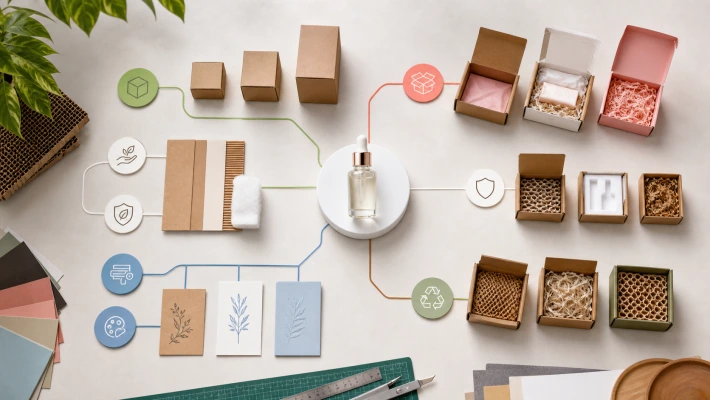
Low-MOQ custom packaging: how to keep it practical
Minimum order quantity is influenced by printing setup, die-making, sheet optimisation, material procurement, finishing and assembly. The lowest possible MOQ is not always the lowest total cost. A tiny run with many finishes can have a high unit price; a slightly larger simple run may be more economical.
Small businesses can improve low-MOQ economics by:
• Using a standard structural size with custom print or a branded sleeve
• Reducing the number of box sizes across related products
• Choosing digital printing for suitable short runs and versions
• Keeping address, batch or seasonal information on a label or insert
• Using one or two strong colours instead of many decorative processes
• Combining similar artworks on a production sheet where feasible
• Reordering a proven structure rather than redesigning every campaign
Ask for price breaks at several quantities and calculate how quickly the stock will be consumed. Storage, damage, design obsolescence and cash cost belong in the decision.
Digital, offset and flexographic printing
Digital printing for short runs
Digital printing can reduce setup and support multiple designs, personalisation or rapid launches. It is often attractive for prototypes and lower volumes. Substrate range, colour matching, ink durability and unit cost should be confirmed.
Offset printing for detail and scale
Offset printing is widely used for high-quality folding cartons and can produce detailed graphics and controlled brand colour. Setup, plates and finishing make planning important, while longer suitable runs can improve unit economics.
Flexographic printing for corrugated packaging
Flexographic printing is efficient for corrugated cases and repeated production. Artwork should respect line, registration and tonal limits. Direct flexo and pre-printed liner approaches have different capabilities.
A packaging partner should recommend a process based on artwork, quantity, board, finish and deadline—not force every project into one machine.
What determines custom packaging cost?
Box cost is created by several connected variables:
• Finished dimensions and sheet utilisation
• Board type, grade, thickness and availability
• Order quantity and number of artwork versions
• Printing method, colour coverage and colour count
• Die, plates and one-time development costs
• Lamination, coating, foil, embossing, windows or special textures
• Insert design, gluing, assembly and packing
• Quality inspection, bundling, freight and taxes
Request a separated quotation for one-time and repeat costs. A die may be reusable if the structure and supplier remain unchanged. Clarify ownership, storage and usable life of tools and artwork files.
Calculate cost per successful delivered product. A weaker box that increases damage, filler and returns can be more expensive than a slightly higher-priced tested structure.
Prototype before placing the production order
A structural white sample confirms fit, opening, closure and assembly. A printed proof checks artwork, hierarchy and approximate colour. A production-intent prototype brings structure, board, print and finish together. Each answers a different question.
Pack the real product and conduct handling tests appropriate to the route. Test drops, vibration, compression, leakage, abrasion and temperature or humidity exposure where relevant. Small businesses do not always need a full laboratory programme, but they do need a deliberate trial.
Give samples to someone who did not design them. Observe whether they understand how to open, remove, reuse or dispose of the pack. A confusing opening experience will affect real customers.
Sustainable packaging without greenwashing
Sustainability is not a colour palette. A green leaf printed on a box does not prove lower impact. Begin by eliminating unnecessary volume and components. Use the least material that still protects the product, choose responsible fibre, design for separation and recycling, and communicate disposal accurately.
Recycled content, certified sourcing, compostability and recyclability are different claims. They require different evidence and may depend on local collection infrastructure. Avoid absolute phrases such as “100% eco-friendly” unless a defensible, specific meaning and evidence exist.
Single-material paper solutions can simplify disposal, but barrier coatings, windows, magnets, foam and lamination may change the pathway. Ask the supplier to identify each material and its function.
Packaging artwork checklist
• Use the final approved dieline at correct scale.
• Keep important content away from cuts, creases, glue and closures.
• Convert images and colours for the agreed print process.
• Provide adequate image resolution and outlined or packaged fonts.
• Check spelling, legal information, ingredients, warnings and country requirements.
• Verify barcode size, contrast, quiet zone and scanning on the final material.
• Mark varnish, foil, embossing, white ink or cut layers clearly.
• Approve the artwork revision and retain the signed proof.
How to evaluate a packaging manufacturer
Look beyond a gallery of attractive boxes. Ask whether the manufacturer can advise on structure, create and test prototypes, specify materials, control colour, manage variable SKUs and document quality. Review samples that are similar in board, print and complexity to your project.
Clarify lead time from artwork approval, sampling rounds, acceptable quantity tolerance, defect handling, packing method and delivery schedule. Discuss reorder continuity: can the same board and colour be obtained later, and what variation is normal?
A strong partner asks questions about the product and route before quoting the finish.
Frequently asked questions
What is the minimum order quantity for custom boxes?
There is no universal MOQ. It depends on structure, material, print method, finish and supplier setup. Ask for options across digital, standard-size and fully custom production.
Which box is best for a small e-commerce brand?
A right-sized corrugated mailer or shipping carton with a simple branded element is a common starting point, but fragile, liquid, food or regulated products need specialised assessment and testing.
Can packaging be premium without foil or lamination?
Yes. Good structure, precise fit, strong typography, controlled colour, tactile paper and a thoughtful opening sequence can create premium value with fewer processes.
How do I reduce custom box cost?
Reduce sizes and versions, simplify finishes, improve sheet utilisation, use variable labels or sleeves and place planned repeat orders. Do not cut the material or protection below tested requirements.
Design packaging for the business you are building
Custom packaging should protect the present product and remain practical as orders grow. Start with data, simplify the structure, prototype on the real route and make claims that can be supported. A memorable unboxing experience is strongest when it is easy to produce again and again.
Cuboid Packaging develops packaging designs and solutions for product requirements, including custom, recyclable and biodegradable paper-based options with low-MOQ possibilities. A product sample, monthly volume and distribution brief can turn a broad idea into a testable box.
Note: Packaging performance, food or product-contact suitability, regulatory labelling and sustainability claims must be confirmed for the specific product, material, destination and supply chain. Prices and MOQs vary by specification and production conditions.