
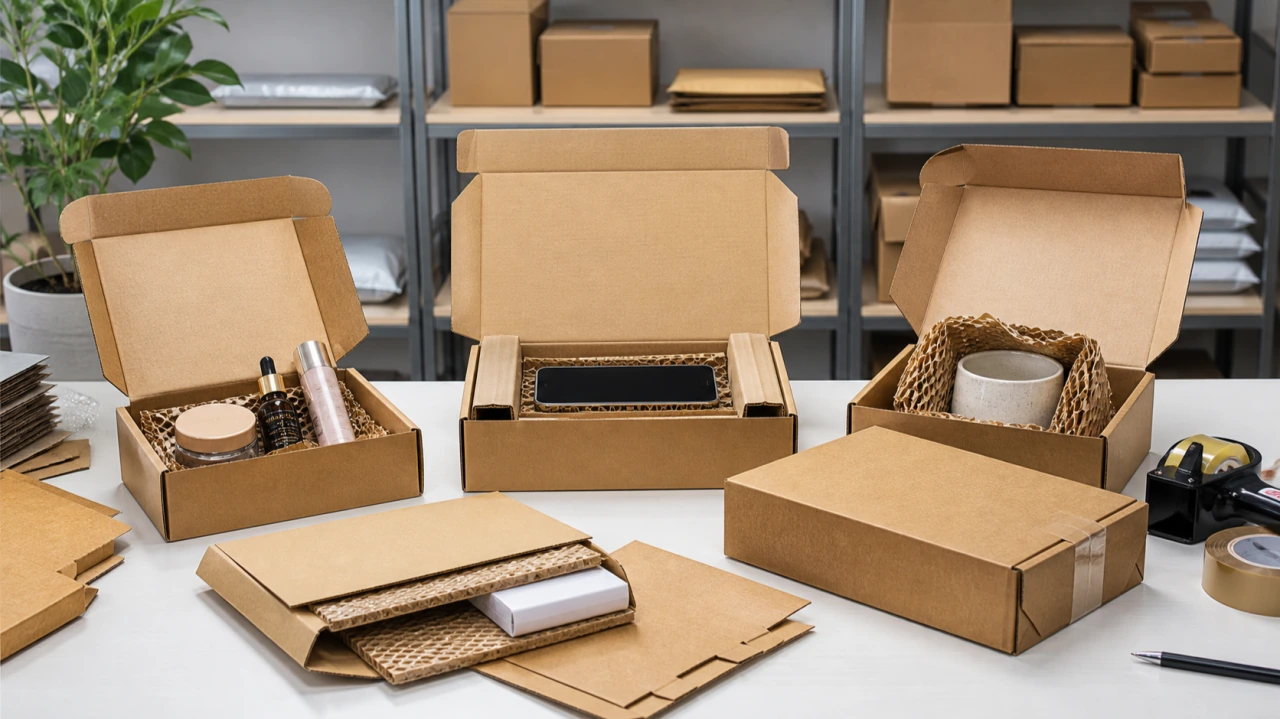
An e-commerce shipping box has one difficult job: deliver the product in saleable condition through a journey the brand does not control. Parcels are stacked, dropped, compressed, exposed to vibration and handled alongside thousands of different shapes. At the same time, the box affects courier charges, packing speed, customer perception, material use and return rates.
Businesses searching for e-commerce shipping boxes in Chennai often begin with price per carton. The better starting point is cost per successful delivery. A cheaper oversized box can increase filler, dimensional weight and damage. A premium printed mailer can also waste money if the product needs a simpler corrugated shipper. This guide explains how to right-size, specify and test packaging for real distribution.
Quick answer: Measure the product and its vulnerable points, map the courier journey, choose an appropriate corrugated grade and box style, reduce empty space, engineer inserts only where needed, test compression and drops, make packing repeatable, and calculate total delivered cost rather than carton price alone.
1. Audit the product before selecting a box
Record maximum product dimensions, packed weight, fragility, surface sensitivity, centre of gravity and orientation. Identify protrusions, glass, pumps, caps, screens, corners or loose components. Include retail packaging and every accessory. Variations between units matter; design from realistic tolerances rather than one ideal sample.
Ask how the product fails. Does it crack, dent, leak, scratch, bend or become unsaleable because the retail box is crushed? The answer determines whether protection should come from corrugated structure, cushioning, restraint, moisture control or improved primary packaging.
2. Map the distribution environment
A parcel may travel from factory to fulfilment centre, move through conveyor systems, ride in mixed-load vehicles and reach a local delivery agent. Marketplace fulfilment, direct courier, hyperlocal delivery and pallet shipment create different hazards. Note stacking height, journey duration, climate, handling frequency and whether returns use the same pack.
Design for the expected route, then test for foreseeable misuse. Packaging that survives careful in-house handling may fail after repeated drops and compression.
3. Understand dimensional weight
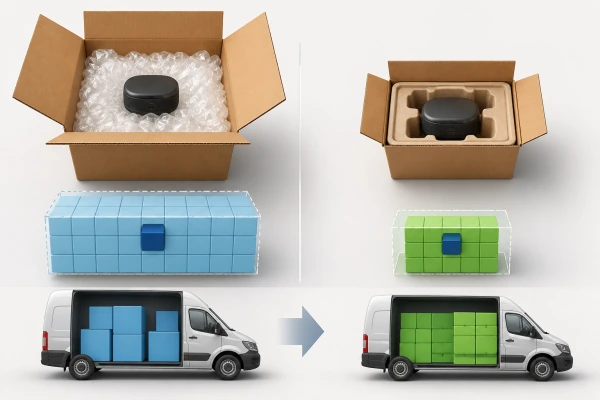
Many carriers charge using the higher of actual weight and a dimensional or volumetric weight calculated from parcel size. The divisor and rounding rules vary by carrier and service. This means a lightweight product in a large box can cost as though it were much heavier.
Obtain current carrier formulas and test proposed external dimensions. Reducing a box by a few centimetres may move it below a billing threshold, but never remove protective clearance blindly. Right-sizing balances freight, material and damage risk.
4. Choose the box style for the operation
Regular slotted cartons
These are efficient for many products, simple to produce and familiar to packing teams. They normally require tape and may use pads or inserts.
Die-cut mailer boxes
Mailers can provide a clean opening experience and integrated flaps. They use more board area and tooling, so the value should be tested against volume and brand objectives.
Five-panel, wrap-around and specialised cartons
Long, shallow or irregular products may fit better in a format designed around their geometry. A packaging manufacturer can compare board usage, protection and packing speed.
5. Specify corrugated board intelligently
Corrugated performance depends on liner and medium quality, flute profile, paper strength, board construction, moisture and converting—not only the number of plies. Single-wall board may suit many light products; heavier, fragile or long-distribution packs may require a stronger construction.
Share product weight, internal dimensions, stack requirement and route with the manufacturer. Avoid copying a board specification from an unrelated product. Excess strength increases material and freight, while insufficient strength creates collapse.
6. Control empty space and movement
Empty space increases box size and allows the product to accelerate before impact. Reduce it through right-sized cartons, paper pads, corrugated fitments, partitions, moulded fibre or other appropriate materials. The goal is controlled restraint, not simply filling every gap.
Fragile products may need cushioning that absorbs impact without bottoming out. Heavy items need strong blocking so they do not punch through walls. Test the complete packed system; a cushioning material cannot compensate for a weak carton or loose closure.
7. Design inserts for protection and packing speed
An insert should locate the product, protect critical zones and be easy to assemble. Complex fitments may slow packing or be installed incorrectly. Use clear orientation and poka-yoke features where practical. Prototype with actual products from multiple batches.
Paper-based inserts can simplify recycling and brand communication, but they still require performance testing. Avoid unnecessary mixed materials and adhesives when a folded board solution can work.
8. Protect against moisture, dust and leakage
Chennai and wider South Indian logistics can expose packs to humidity and rain. Corrugated board loses strength when wet. Use suitable primary seals, liners or barriers for products that leak or absorb moisture, and keep secondary packaging stored off the floor in dry conditions.
Do not claim water resistance unless the full pack has been evaluated. Surface coating, tape and open edges influence performance differently.
9. Select printing that supports logistics
Shipping boxes need readable barcodes, handling information and branding that survives abrasion. Flexographic printing is common for corrugated cartons and can be efficient for larger runs. Digital printing may suit short runs, testing and variable work. Labels may be practical for frequently changing product data.
Keep barcodes away from folds, tape and rough surfaces. Maintain contrast and quiet zones. Too much ink coverage can affect cost, recycling perception and converting, so use graphics strategically.
10. Engineer a reliable closure
Tape width, adhesive, application pressure and carton surface matter. Overlapping flaps or tamper-evident features may be valuable for specific products. Staples require safety and marketplace consideration. Self-locking formats should be tested after repeated opening and under load.
Write a packing standard showing product orientation, insert sequence, tape pattern, label position and final checks. Consistency reduces failures more than an expensive material used inconsistently.
11. Test before scaling
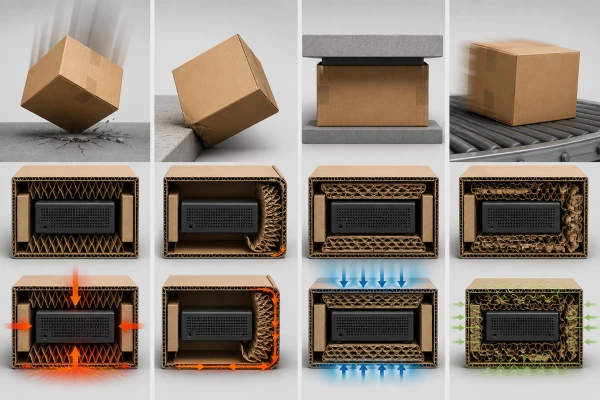
Begin with dimensional and visual checks, then simulate the real route. Drop testing examines impacts on faces, edges and corners. Compression testing relates to stacking. Vibration testing reveals movement and abrasion. Climate conditioning may matter when humidity changes board strength.
Use recognised protocols where customer or marketplace requirements apply. A passing laboratory test does not eliminate the need for controlled pilot shipments. Record damage, customer feedback and courier handling from the pilot.
12. Use returns as packaging data
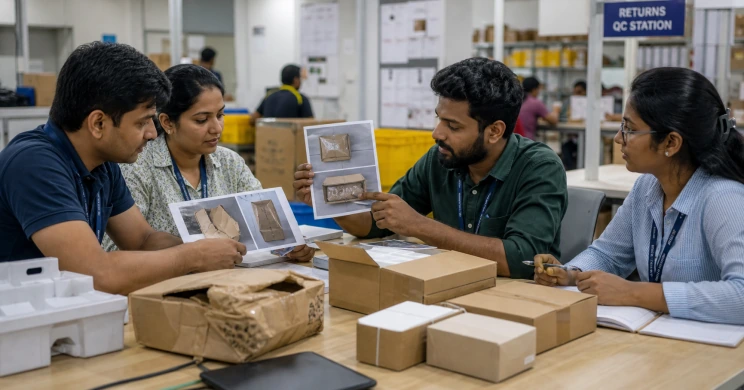
Classify returns by cause: product defect, wrong item, transit damage, leakage, crushed retail box, customer preference or delivery failure. Photograph packaging damage and record location. If the same corner or component fails repeatedly, the pack can be improved precisely.
For returnable packs, make reopening and resealing understandable. A frustrated customer may use excessive tape or an unsuitable bag, increasing reverse-logistics damage.
13. Calculate total packaging cost
Include box, insert, tape, label, filler, labour, storage, wastage, tooling, freight, dimensional charges, damage replacement, reverse logistics and customer-service time. Compare alternatives at expected order volume. A carton that costs slightly more can be cheaper overall if it packs faster and reduces billed volume.
Standardise sizes only after analysing the product range. Too many sizes complicate inventory; too few create empty space. A rational box library can balance both.
Supplier brief checklist
• Product dimensions, weight, tolerance and photographs
• Monthly volume and seasonal peaks
• Courier, marketplace and route information
• Internal and maximum external dimensions
• Required board performance and testing
• Insert, closure, printing and barcode needs
• Packing speed and storage constraints
• Sustainability and documentation requirements
• Prototype, pilot and delivery schedule
Plan packaging inventory for growing order volumes
Corrugated cartons occupy warehouse space and can lose strength when stored poorly. Estimate normal demand, campaign peaks, supplier lead time and safety stock for each size. Keep cartons flat, dry, covered and away from direct floor contact. Use first-in, first-out control when artwork or product details change.
For Chennai businesses serving Tamil Nadu and national markets, plan how cartons move from the manufacturer to the fulfilment location. Freight on empty boxes can become significant, especially for large die-cut formats. Compare delivery frequency, bundle quantity and minimum production economics. A nearby supplier can support faster replenishment, but specification control remains essential when more than one factory supplies the same size.
Improve packaging through a monthly damage review
Bring operations, customer service, procurement and the packaging supplier together for a short review. Examine photographs, courier, product, box size, batch and failure mode. Track damage rate and packaging cost per order. Prioritise the few combinations causing most loss, run a controlled change and compare results before rolling it across the catalogue. Continuous small improvements are usually more reliable than a complete redesign based on one complaint.
Frequently asked questions
Which corrugated box is best for e-commerce?
There is no universal grade. The correct box depends on product, weight, size, fragility, route, stacking and carrier requirements.
How can dimensional weight be reduced?
Right-size the external carton, redesign inefficient inserts, pack components more compactly and compare carrier thresholds—without sacrificing protection.
Is a printed mailer better than a plain shipping carton?
A mailer can improve presentation, but a plain optimised shipper may be more economical. Test customer value, protection, board usage and freight.
How many box sizes should a small business keep?
Use order and product data to create the smallest practical set that controls void space. Review it as the catalogue changes.
Optimise for successful deliveries
The most effective e-commerce packaging is not the box with the lowest unit price or the most decoration. It is the right-sized system that protects the product, moves efficiently through packing and logistics, and gives the customer confidence at delivery.
Cuboid Packaging manufactures corrugated, die-cut, shipping and custom-printed paper packaging in Chennai. Businesses can share actual product and distribution data to develop prototypes, test alternatives and create a repeatable box specification.