

Start with the decision you need to make
Two sample boxes arrive at your office. One looks more substantial. The other is easier to assemble. Both hold the product neatly, and both appear suitable when photographed on a table. Which one should become your next production order?
The answer needs more than a visual preference. A packaging trial should connect a specific design decision with evidence from the way your business actually packs, stores and dispatches goods. For a Chennai brand, that could mean comparing two closure arrangements, checking whether a revised internal fit works consistently, or deciding whether a construction change is ready for a limited launch.
This guide proposes a practical approval workflow. It is not a laboratory test procedure, a promise of damage-free delivery or a substitute for customer-specific requirements. Its purpose is to help procurement, operations and packaging suppliers agree on what they are comparing, what counts as success and what remains uncertain before committing to production.
Key takeaways
Define the purchasing decision before choosing a test.
Compare identified configurations against acceptance criteria agreed in advance.
Separate laboratory evidence, packing-floor observations and limited field feedback.
1. Write one clear trial question
Begin with a sentence that can be answered. For example: “Can the revised box be packed consistently by our usual team while meeting the agreed product and presentation requirements?” That question is more useful than “Is this a good box?”
Separate essential requirements from preferences. Product condition may be essential; an extra decorative detail may be optional. A design that is attractive but fails an essential requirement should not win through a high average score. Agree on this distinction before anyone sees the results.
Name the decision owner and the people who must contribute. Procurement can compare quotations, operations can observe packing, quality can assess condition, and the brand team can evaluate presentation. One person should consolidate the findings so approval does not depend on several disconnected messages saying that the sample looks fine.
2. Describe the real distribution route
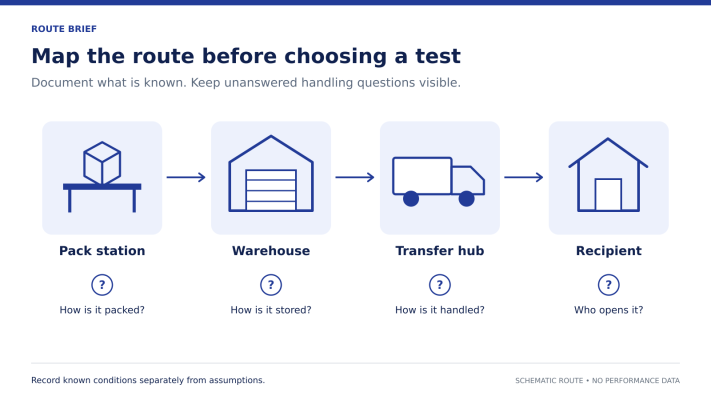
Build a short route brief: where packing happens, whether cartons leave individually or on pallets, where storage occurs, how shipments are transferred and who opens them. Record known handling conditions and unanswered questions separately. A guess about the route should not quietly become a test requirement.
The International Safe Transit Association, in its Getting Started with Design & Testing guidance, emphasizes understanding the actual distribution environment before selecting a test. That is the basis for asking a laboratory the right questions, rather than choosing a familiar test name first.
For your internal brief, ask the dispatch team to describe an ordinary shipment and an awkward one. Does a master carton remain intact to the destination? Is it split into individual parcels? Is the final recipient a retailer or a consumer? These details help identify which packaging configuration the trial must represent. Keep customer names and commercially sensitive route information out of public-facing material.
3. Compare complete, identified configurations
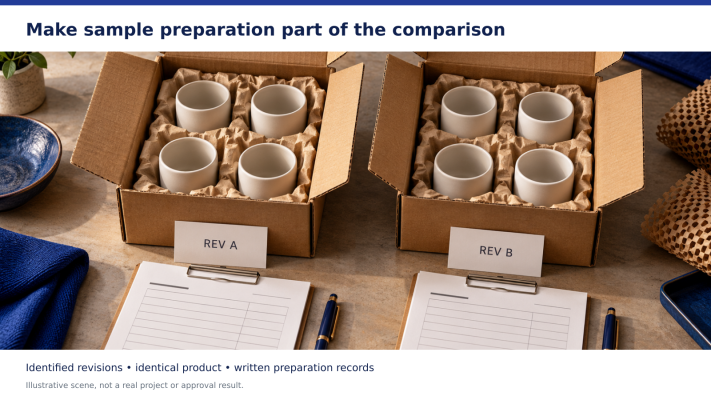
Give each candidate a revision reference. Record the box specification, internal components, closure materials, product quantity, packing arrangement and artwork version. Include a photograph showing the intended packed configuration, not only the empty sample.
Where possible, compare one deliberate change at a time. If the board, dimensions, insert, tape and packing method all change together, the trial can still compare complete alternatives, but it will be harder to explain which change caused a difference. State that limitation honestly.
Keep the existing approved configuration as the baseline when there is one. If this is a new launch, describe the proposed baseline rather than inventing a history of successful use. Make sure quotations refer to the same revisions that were assessed. An approval photograph of one construction and a purchase description of another create avoidable ambiguity.
4. Agree on acceptance before testing
Write down what the product must do after evaluation. Depending on the product, that may include a functional inspection, an appearance check or confirmation that components remain in their intended positions. Ask the product owner to define the appropriate inspection method; the packaging team should not guess what constitutes acceptable product performance.
Assess packaging condition separately. A scuffed outer surface and an unusable closure are different observations. Describe permitted cosmetic changes, unacceptable opening or deformation, and any presentation requirements the receiving customer has specified. Photographs or agreed reference samples can make subjective language easier to interpret.
ISTA recommends defining product damage tolerance and package degradation allowance before testing. Translate that principle into a signed, understandable acceptance sheet. Avoid vague phrases such as “minor damage acceptable” unless the team has agreed what minor means. Do not relax a criterion after a favorite design performs poorly without documenting a new decision and its reason.
5. Ask a qualified laboratory to select the relevant protocol
An informal handling exercise can reveal usability issues, but it should not be described as an ISTA-certified test. ISTA’s Test Procedures overview distinguishes screening tests from simulations of particular distribution environments. Different objectives require different methods.
Share the route brief, product details and customer requirements with the laboratory. Ask it to confirm the appropriate current procedure, sample requirements, conditioning, evaluation boundaries and report deliverables. Do not invent drop heights or vibration settings from an online summary.
Geography also matters. ISTA now lists an India-focused parcel procedure, 3P, alongside other procedures. This does not mean every Indian shipment requires that test, or that a commonly mentioned procedure is automatically wrong. It means the selected protocol should have a documented rationale. Ask the laboratory to explain that rationale in terms your team can understand.
6. Make sample preparation part of the trial
Use a written preparation instruction so each candidate is packed as intended. Identify who packed each sample, the product version, the date and any departure from the agreed method. A sample that needs special care from the designer may not represent routine operations.
Confirm with the laboratory how samples should reach it and how many are required. Discuss whether prototypes sufficiently represent production materials and processes. If they do not, identify what must be checked again using production-representative samples.
Prepare a separate untouched reference for visual comparison where useful. Do not open, repair, retape or substitute a test sample during a formal sequence unless the procedure and laboratory explicitly permit it. ISTA warns that opening a package during a certification test can alter its condition and invalidate the result. Keep exploratory investigations separate from formal approval testing.
7. Observe the packing task, not only the finished pack
Run a controlled packing-floor review alongside the technical evaluation. Ask regular operators to follow the proposed instructions using the normal workspace. Observe where they pause, reinterpret a step, reach for extra material or need help closing the pack.
Record the observation before proposing a solution. “Operator added an extra strip of tape” is more useful than “closure was bad,” because it preserves what happened. Ask whether the extra step came from unclear instructions, unfamiliarity or the design itself.
If packing time matters, agree how it will be measured and report the conditions. A short trial with a newly trained operator should not become a confident productivity forecast. Also review counting, label placement and the ability to identify the correct orientation. These are practical considerations that may influence the purchasing decision even when both candidates meet the protection criteria.
8. Use a field pilot to answer remaining questions
After the necessary technical approvals, consider a limited, authorized dispatch pilot. Define which routes and recipients are included, what evidence will be collected and who will follow up. Do not use an unapproved trial to expose customers to a known product risk.
Ask recipients for structured observations rather than a general “arrived okay.” Was the product usable? Was the package intact? Was opening straightforward? Were all components present? Make the questions relevant to your product and avoid requesting unnecessary personal information or photographs.
Treat the findings as observations from that pilot, not proof of a universal damage rate. A handful of successful deliveries does not establish performance across every route or season. Compare the feedback with the laboratory findings and record discrepancies for investigation. The purpose is to learn whether the approval assumptions fit actual dispatch practice.
9. Read the result as a decision, not a competition
Consider a hypothetical comparison. Design A meets the agreed condition checks, but the packing team repeatedly misinterprets its closure sequence. Design B also meets those checks and is easier to pack, but requires a different storage arrangement. These are illustrative possibilities, not a Cuboid customer case study.
The next step is to investigate the unresolved operational issues, not simply award a winner to the sample that looks stronger. Could clearer instructions resolve Design A’s problem? Can the warehouse accommodate Design B? Would either change require another assessment?
Compare the commercial consequences only after essential requirements are satisfied. FedEx’s packaging laboratory guidance highlights costs beyond the box itself, including replacements, re-shipping and handling labor. For your business, build the comparison from your own records. Avoid adding speculative savings to make a preferred design appear financially superior.
10. Issue an approval that can be reproduced
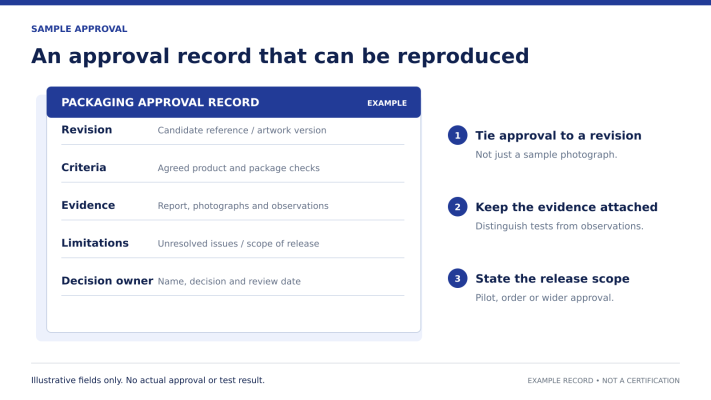
Your approval record should identify the chosen revision, product configuration, preparation method, acceptance criteria, evidence reviewed, unresolved limitations and authorized decision maker. Attach the relevant report and photographs. State whether approval is for a pilot, a particular order or a wider release.
Include the practical instructions that production needs: which configuration to make, which packing instruction to use and which checks must accompany the first batch. Keep a controlled reference sample if your quality process uses one. An attractive sample on a shelf is not enough if no one knows which revision it represents.
Finally, agree on review triggers. A product change, packaging revision, new dispatch channel or repeated complaint should prompt a check of whether the old evidence still applies. The response may be a document review, a targeted investigation or new testing. Decide according to the change and its risk, rather than assuming every historical approval transfers automatically.
Make the next sample meeting more useful
Before your next packaging review, bring a one-page brief containing the decision question, route, candidate revisions, essential acceptance criteria and people responsible for approval. This gives the supplier and your team a common starting point.
A disciplined trial does not remove uncertainty from distribution. It makes the uncertainty visible enough to manage. That is a stronger basis for a production order than choosing a sample by appearance, habit or a test name that has not been matched to the job.
Quick questions before approval
Can we approve a box from one successful delivery? Treat that delivery as one observation, not evidence for every route. Decide what additional checks the product, customer and distribution environment require.
What should procurement receive? The approved revision, evidence reviewed, limitations, decision owner and instructions that connect approval to the actual order.
Planning a packaging revision? Discuss your product, dispatch route and sample requirements with Cuboid Packaging at cuboidpackaging.com. Bring a clear trial brief so the next sample conversation can focus on the decision your business needs to make.
Sources and further reading