A carton can arrive in good condition, pass the first visual check and still buckle before it leaves the warehouse. The natural response is to ask for a heavier box. Sometimes the material specification does need changing. Sometimes the same box has been asked to carry a different load, stand on a different pallet or wait much longer than anyone allowed for.
For a purchasing team, the useful question is: what changed between the approved sample and the stored load? That question turns a frustrating packaging complaint into something the warehouse, procurement team and box supplier can investigate together.
Here is a practical guide for businesses buying corrugated boxes in Chennai and shipping across Tamil Nadu or farther afield. It explains what to observe, what to record and which questions to take into the next packaging discussion.
The short answer
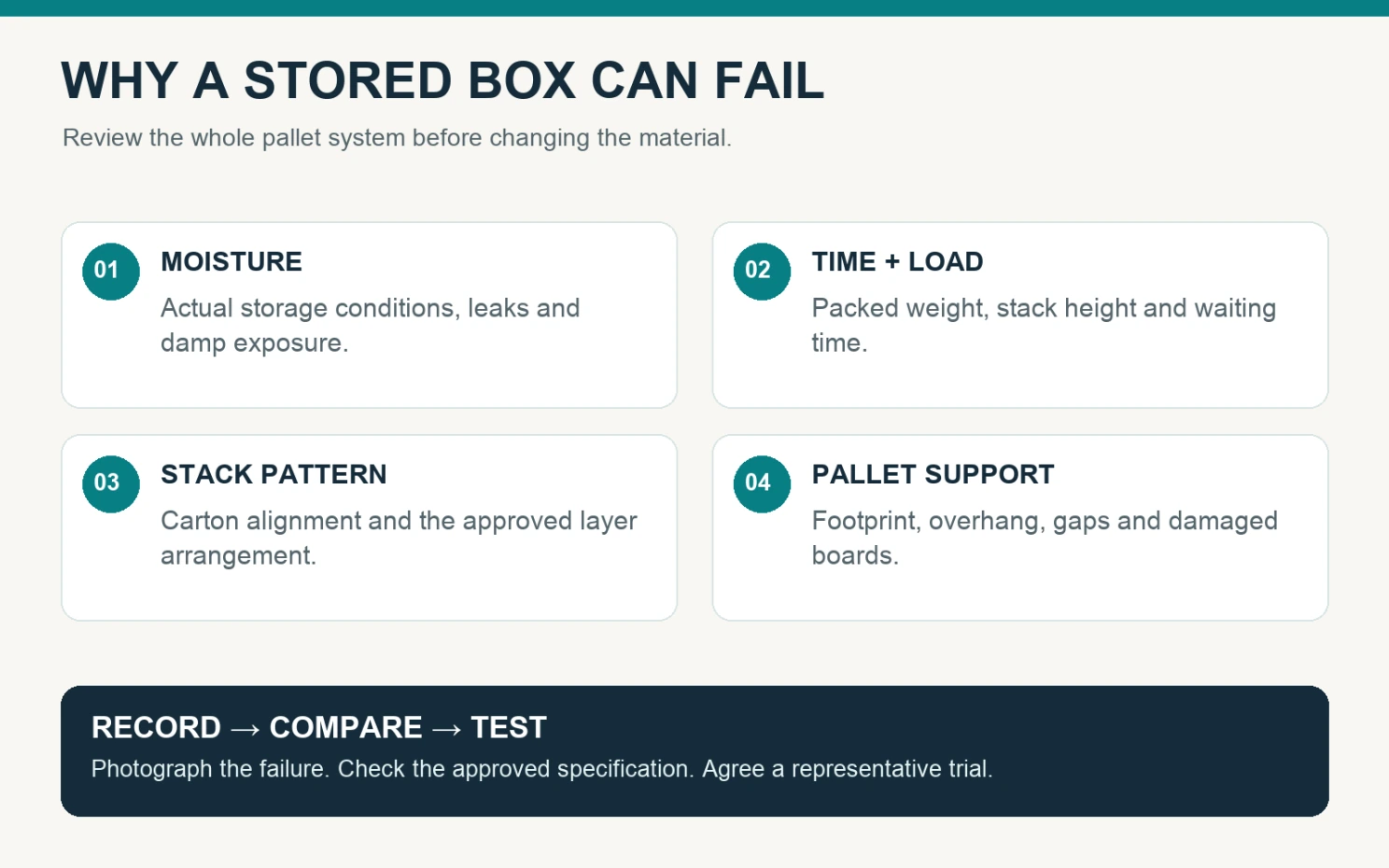
Corrugated boxes can collapse when the load and storage conditions exceed what the complete package can withstand. Moisture, time under load, stacking pattern, pallet support, damage and box construction all matter. A board specification alone does not describe the performance of an entire pallet load.
Approve the box for the way it will actually be stored, not just for the way it looks on the packing table.
1. Humidity changes the conditions around the box
Rain does not have to fall directly on a carton for moisture to become relevant. Corrugated material exchanges moisture with its surroundings. A dry sample assessed in an office may therefore face a different environment near a loading bay, a damp wall or an unprotected storage area.
The Fibre Box Association identifies relative humidity as a significant consideration in corrugated packaging performance. Its technical research programme treats humidity as a design variable rather than an afterthought. Read the FBA technical overview.
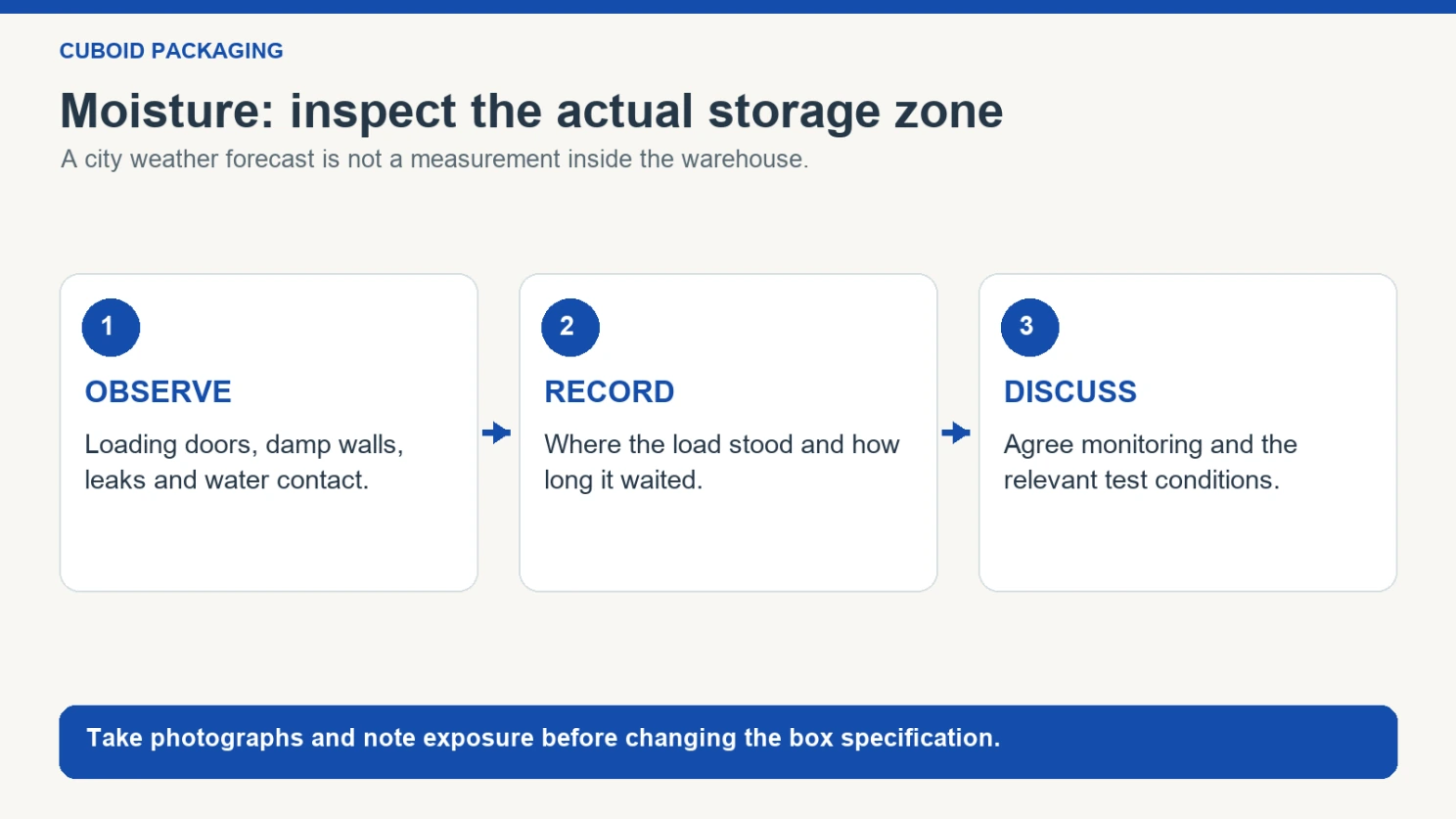
For a coastal-city operation such as Chennai, make the actual storage environment part of the brief. Do not substitute the city's weather forecast for measurements inside the warehouse. Conditions near the roof, floor, loading door and internal storage zones may differ.
Start with a simple record: where the affected pallet stood, whether cartons felt damp, how long the load waited, and whether there was any leak or water contact. If recurring failures justify monitoring, agree with the technical team where humidity and temperature should be logged and how the results will be used.
2. A short compression test and a long wait are different questions
“It held yesterday” is useful information, but it is not proof that the stack can remain there indefinitely. Storage duration belongs in the design brief. A pallet dispatched promptly and a pallet waiting through a prolonged delay are different operating cases.
Research on corrugated packaging recognises time-dependent compression behaviour and environmental exposure when considering stacking performance. The practical takeaway is to tell the supplier the expected dwell time, including a realistic delay scenario, rather than only the product weight. See the published research on creep lifetime and stacked boxes.
Keep dispatch dates, packing dates and pallet identifiers connected. If failures occur only in older stock, that pattern is worth investigating. It may point to an exposure or loading problem that a quick incoming inspection cannot reproduce.
3. Stacking pattern changes how the load travels
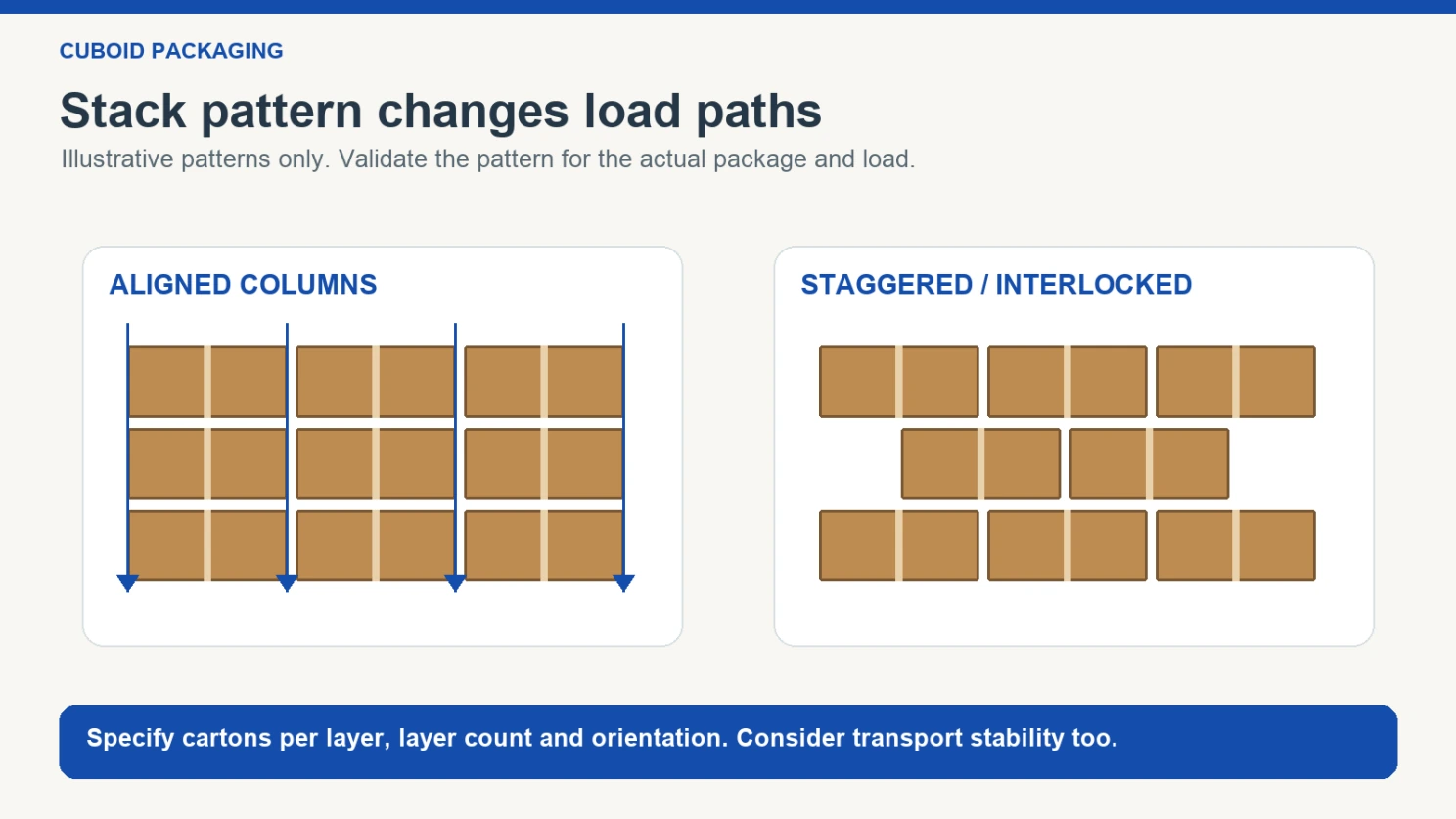
Two pallet loads can contain the same cartons and the same total weight, yet arrange that weight differently. In aligned columns, box edges are positioned above corresponding edges below. Interlocked patterns change those relationships.
Neither arrangement should be selected by appearance alone. The Fibre Box Association reports research comparing aligned, interlocked and hybrid patterns, confirming that stacking arrangement influences compression performance. Results from one tested design should not be treated as a universal percentage for every box. Read the FBA stacking-pattern study summary.
Ask for a drawing or photograph of the approved pallet pattern. Include the number of cartons per layer, the number of layers and the carton orientation. A packing instruction that says only “stack neatly” leaves too much room for variation between shifts.
Also consider load stability during movement. A pattern chosen for vertical support still needs an appropriate unit-load securing plan. Let the packaging and logistics teams consider compression and transport stability together rather than solving one by creating another problem.
4. Pallet fit is part of packaging design
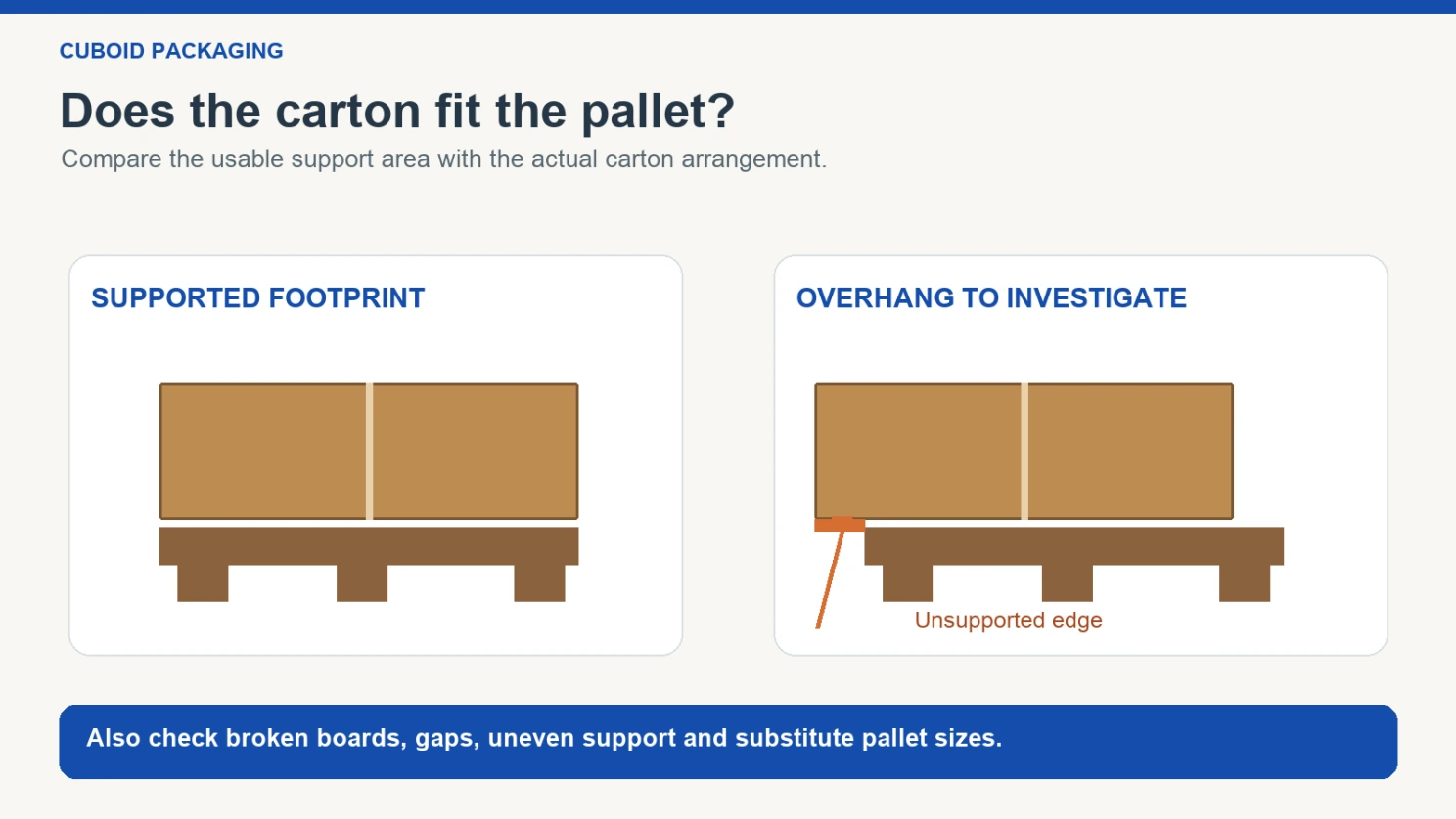
A carton hanging beyond a pallet edge has less support where the overhang occurs. Gaps, broken boards and uneven support surfaces can also change the way weight is carried. It is worth inspecting the empty pallet, not only the damaged cartons.
Research on palletised boxes identifies pallet support and alignment as factors affecting load distribution. That is why a pallet footprint should be agreed before finalising the outer carton dimensions. See the research on box preparation, stacking and compression.
Measure the usable support area of the pallet actually being purchased. Check whether the dispatch team sometimes uses a substitute size. A carton designed around one base may overhang another even when staff follow the same layer count.
Photograph the lowest layer from two sides before wrapping a trial load. Those photographs often make an unsupported edge easier to notice than a specification sheet does. Keep them with the approved packing instruction.
5. Check the complete box, not just the board label
Edge Crush Test, usually shortened to ECT, evaluates a sample of corrugated board under edgewise compression. Box Compression Test, or BCT, evaluates an assembled box. The two describe related but different things. Billerud explains ECT and BCT in its corrugated materials guide.
A buyer does not need to become a laboratory specialist. The buyer does need to ask what was tested, under which conditions and whether the sample represents the supplied construction. Record the board construction, box style, dimensions, closures and any inserts alongside the result.
A board test can also help check whether received material matches the specification. Westpak describes ECT as one useful source of that information. It does not replace evaluating the finished package for its route and load. Read Westpak's ECT explanation.
A warehouse example: investigate before increasing GSM
Illustrative scenario, not a Cuboid customer case study.
A manufacturer notices buckled cartons in the bottom layer of one dispatch lot. The purchase specification is unchanged. Before reordering heavier material, the team compares the affected pallet with a recent successful one.
The inspection finds three differences: a substitute pallet is smaller, the cartons have been stacked in a different pattern, and the shipment has waited longer near the loading area. None of those observations proves the cause by itself. Together, they give the team a sensible test plan.
The supplier and warehouse agree to compare the approved arrangement with the changed arrangement, using representative packed products and documented conditions. They record damage, support, closure behaviour and handling observations. The final decision may involve a material change, a pallet change, revised stacking instructions or a combination. The investigation avoids paying for extra paper without knowing whether it addresses the failure.
A ten-minute damage review
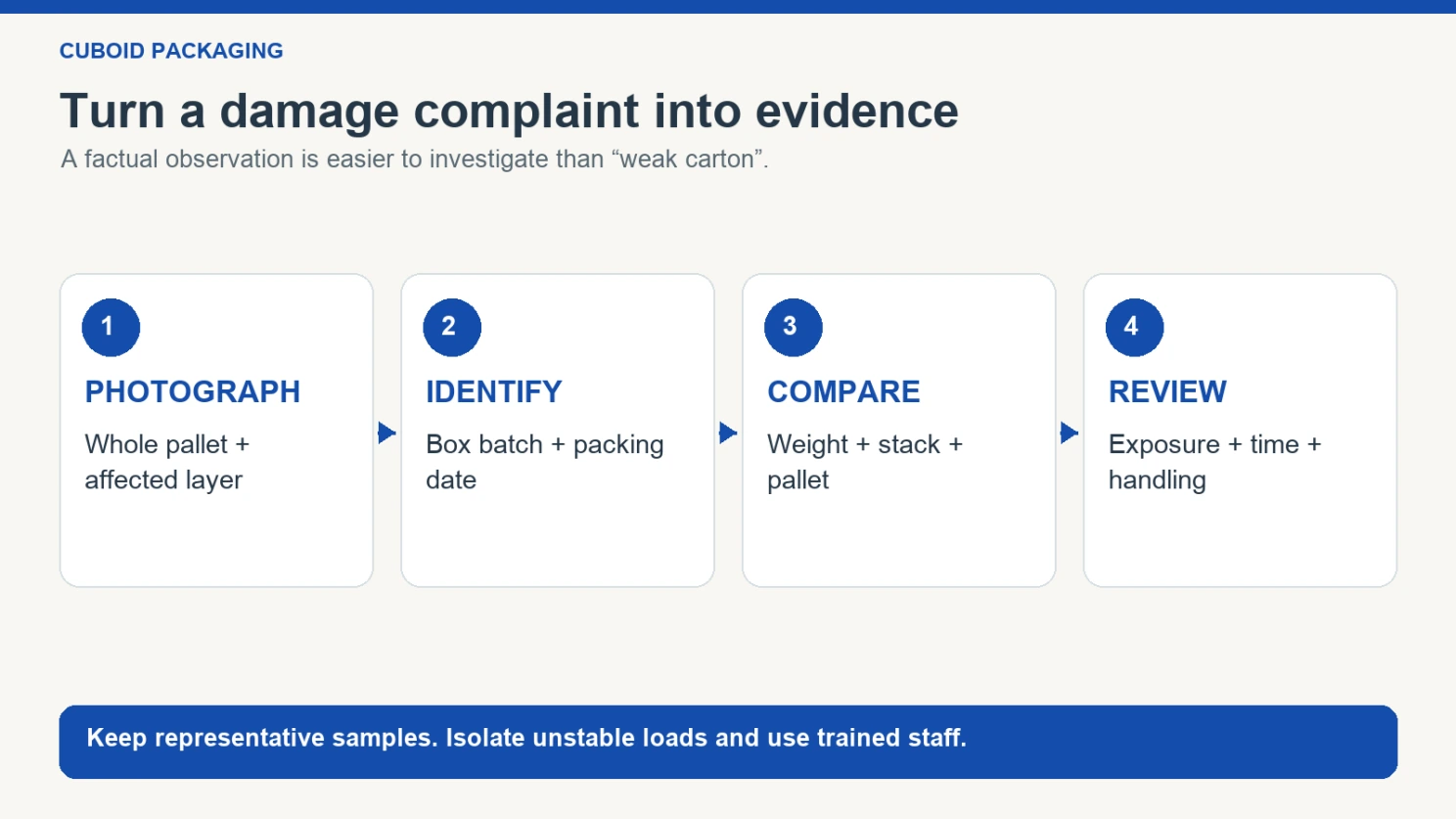
When a collapse is reported, collect evidence before everything is unpacked or discarded:
- Photograph the complete pallet and the affected layer.
- Record the box batch, packing date and time in storage.
- Check actual packed weight against the original brief.
- Measure the pallet and note damaged boards or overhang.
- Compare the stack with the approved pattern.
- Record water contact, visible dampness and unusual exposure.
- Keep representative damaged and undamaged cartons where practical.
- Note whether failure appeared before movement, after movement or at receipt.
Make the review factual. “Weak carton” is a conclusion; “bottom front corner buckled after six days on pallet type B” is an observation someone can act on. Safe handling comes first: isolate unstable loads and use trained staff to assess them.
What to include in the next box enquiry
Send the supplier the product dimensions, total packed weight, quantity, storage duration, expected stack, pallet dimensions and transport route. Explain whether the product supports any load internally or whether the box must carry it independently. Include fragile areas, internal divisions and closure requirements.
Agree the acceptance checks before placing the repeat order. A sample approval should identify the exact version being approved, not simply the latest photograph in a message thread. When the product, pallet or route changes, revisit the specification.
For repeated orders, keep one controlled record that purchasing, packing and dispatch can access. A dated drawing, approved sample reference and clear stacking image reduce the chances of a well-intended substitution becoming an unnoticed design change.
Questions buyers often ask
Will a thicker box always solve collapse?
No single material change answers every failure. First check support, load, storage and construction. A stronger specification may be appropriate, but it should be selected against the actual requirement.
Can one stacking height be used for every product?
No. Packed weight, dimensions, material, duration and environment differ. Establish a validated limit for the specific package and handling arrangement.
Should the supplier see the damaged carton?
Yes, where practical, along with photographs and the operating details. An intact sample and the failed package together provide a more useful comparison than a description alone.
Build the storage plan into the packaging brief
Cuboid Packaging provides custom corrugated, die-cut and printed packaging from Chennai. For a useful first conversation, bring the product and the warehouse story together: what is packed, how it is supported, where it waits and how it travels.
Discuss your packaging requirement: +91 93456 60176 / +91 79042 53042 www.cuboidpackaging.com
Before the next order, ask one question: does the approved box still match the way the business is using it?